

 UV-Vis Home > Groundbased > Stations > Jungfraujoch
|
~ Stations:
|
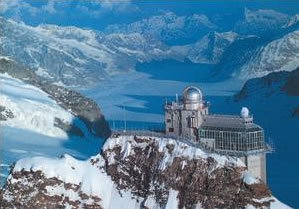
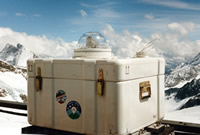
 Jungfraujoch, Switzerland, 46.55°N, 7.98°E Introduction The International Scientific Station of the Jungfraujoch (ISSJ) is a very nice observatory located in the Swiss Alps (46°N, 3570 m). It is part of the NDACC network as one of the primary alpine station. Due to its privilegied position, the station is the base for a lot of scientific work in many varied research fields such as physiology, meteorology, glaciology, atmospheric research... ISSJ participates to a large number of international scientific programmes including European and international satellite validation projects. BIRA-IASB operates a SAOZ instrument since June 1990. The station is also equipped with a high-resolution FTIR spectrometer operated jointly by BIRA-IASB and the Université de Liège (Belgium).
More information concerning the Jungfraujoch research station can be found on http://www.ifjungo.ch/. Instrument and operation
Data Time series of morning and evening twilight observations of O3 and NO2 total
column amounts can be extended back to 1990. BIRA-IASB provides the CALVAL
(http://nadir.nilu.no/calval/index.php) and the GEOMON (http://www.geomon.eu/)
data bases with these data in HDF format. The O3 times series and the NO2
times series cleaned from tropospheric signatures are also available on the
NDACC data base in NASA-AMES format. List of publications Clémer, K., Van Roozendael, M., Fayt, C., Hendrick, F., Hermans, C., Pinardi, G., Spurr, R., Wang, P., and De Mazière, M.: Multiple wavelength retrieval of tropospheric aerosol optical properties from MAXDOAS measurements in Beijing, Atmos. Meas. Tech., 3, 863-878, doi:10.5194/amt-3-863-2010, 2010. [link] Hendrick, F., Mahieu, E., Bodeker, G. E., Boersma, K. F., Chipperfield, M. P., De Mazière, M., De Smedt, I., Demoulin, P., Fayt, C., Hermans, C., Kreher, K., Lejeune, B., Pinardi, G., Servais, C., Stubi, R., van der A, R., Vernier, J.-P., and Van Roozendael, M.: Analysis of stratospheric NO2 trends above Jungfraujoch using ground-based UV-visible, FTIR, and satellite nadir observations, Atmos. Chem. Phys., 12, 8851-8864, doi:10.5194/acp-12-8851-2012, 2012. [link] Gielen, C., Van Roozendael, M., Hendrick, F., Pinardi, G., Vlemmix, T., De Bock, V., De Backer, H., Fayt, C., Hermans, C., Gillotay, D., and Wang, P.: A simple and versatile cloud-screening method for MAX-DOAS retrievals, Atmos. Meas. Tech. Discuss., 7, 5883-5920, doi:10.5194/amtd-7-5883-2014, 2014. [link] |
.jpg)


Last update on 21 Oct 2016